
Home › Crawl Spaces & Finishing
Crawl Spaces and Basement Finishing in Massachusetts and New Hampshire
A damp crawl space and a basement you want to live in share one rule: deal with the moisture first. After that, finishing a basement brings in ceiling heights, alarms, escape windows and your building department. Call (978) 800-2819 or send the form. A person reads every request and replies with what happens next.
- Free for homeowners
- Contractors screened first
- Code basics explained
Ask About Basement Service in Your Area
Tell us about the space and what you want it to become. A person reads it and replies with what happens next.
Please add your name, a 10-digit phone number and a valid email.
Your request didn't go through on our end. Please call (978) 800-2819 so it isn't lost.
Too many requests have come from this connection in a short time. Please call (978) 800-2819 and we'll take it from there.
We couldn't finish the spam check. Wait a moment and send it again, or call (978) 800-2819.
Dry first
Moisture and radon come before drywall
Moisture. EPA puts it simply: "The key to mold control is moisture control," and water-damaged areas should be dried within 24 to 48 hours (EPA mold guide). New Hampshire's health department adds: keep humidity below 60% and never paint over moldy surfaces (NH mold and moisture). A space that still takes on water needs waterproofing and drainage before it gets walls and carpet.
Radon. Radon enters through the foundation, and the only way to know is to test (NH Radon Program). Massachusetts says to test at the lowest livable level, between November 1 and March 31, and strongly recommends a mitigation system at 4.0 pCi/L (MA radon testing). In New Hampshire's August 2023 data brief, about 37% of tested homes were at or above 4 pCi/L (NH radon data brief).
Flood risk. Check your address on FEMA's Flood Map Service Center. Flood insurance doesn't cover finished basement walls, floors, ceilings or carpeting (FEMA basement coverage).
Massachusetts
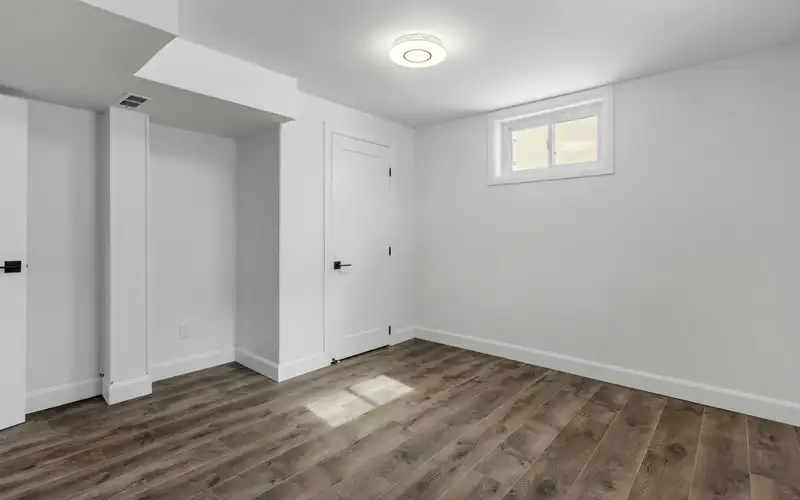
Finishing a basement in Massachusetts
Code basics. Basement habitable space, bathrooms, laundry rooms and hallways may have a ceiling as low as 6 feet 8 inches. Smoke alarms must be listed photoelectric units, with one near the base of the stairs, and at least one carbon monoxide alarm is required on each story, basements and cellars included. A single- or double-hung window used as an escape opening needs at least 3.3 square feet of net clear opening, and doors to habitable rooms must be at least 30 inches nominal width (780 CMR R305, R310, R311, R314, R315).
Permits. The state's guidance chart marks structural carpentry, wallboard and insulation as work needing a permit, while painting, tiling, carpeting and similar finish work are exempt; electrical and plumbing may need their own permits (HIC contractor resources, 780 CMR R105.2). Ask your building department before work starts.
Flood zones. For new construction, substantial improvement or substantial-damage repair in an A zone, a basement floor below grade on all sides must be at or above the base flood elevation plus 2 feet (780 CMR R322.2.1).
Older homes and radon. In homes built before 1978, renovation, repair or painting calls for a licensed lead-safe renovation contractor (lead-safe renovation). New one- and two-family homes in Essex, Middlesex and Worcester counties must have passive radon systems (MA residential radon data).
New Hampshire
Finishing a basement in New Hampshire
Permits and the code. Basement finishing and egress fall under the state building code as adopted in New Hampshire, with permits from your town (RSA 155-A:2). The 2024 code set took effect July 1, 2026, and permits may be filed under either the 2021 or the 2024 codes through December 31, 2026 (Town of Merrimack code page).
Wiring and plumbing. Electrical installations made for pay need a licensed electrician (RSA 319-C), and plumbing needs a licensed plumber; an owner working in his or her own single-family home or townhouse is exempt from plumber licensing but still needs local permits and inspections (Mec 300).
Radon. Testing is free through the state Radon Program at (603) 271-1708. Test in the lowest livable area, usually the basement; New Hampshire does not license mitigation professionals, and the state suggests retesting after mitigation and every two years (testing your home).
New Hampshire basement rules and the towns we cover.
Last verified November 2026. Fees, restrictions and deadlines on this page are due for re-checking by January 2027. New England Basement Pros is a referral service. We don't build, wire or file permits.
FAQ
Crawl space and finishing questions
How low can a finished basement ceiling be?
In Massachusetts, habitable space, bathrooms, laundry rooms and hallways in a basement may have a ceiling as low as 6 feet 8 inches; elsewhere in the house habitable space needs at least 7 feet. In New Hampshire, ask your town building department, which applies the state code as adopted there.
Does a finished basement need an escape window?
That depends on the plan and your building department. In Massachusetts, a single- or double-hung window used as an escape opening needs a net clear opening of at least 3.3 square feet. Settle the window question before the walls go up.
Should I test for radon before finishing?
Both states recommend testing. Massachusetts says to test at the lowest livable level between November 1 and March 31; New Hampshire offers free test kits through its Radon Program. EPA recommends fixing at 4 pCi/L or more, and both states suggest considering it from 2 to 4.
Will flood insurance cover my finished basement?
FEMA says flood insurance does not cover basement improvements such as finished walls, floors, ceilings and carpeting, or most belongings. Look up your flood map on FEMA's Flood Map Service Center before you invest.
What does it cost me to use New England Basement Pros?
Nothing. The request and the referral are free; the contractor prices the work.
Other jobs